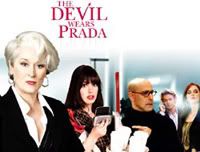
The preview of The Devil Wears Prada was brilliant: it introduced all the major players and set up the premise nicely. Best of all, it was how the movie actually begins, so it didn't give away anything. Fortunately, the movie itself matches the preview in both tone and substance, making Prada an enjoyable experience.
Andy (Hathaway) moves to New York City to be a journalist, and her break might very well be working for Runway, the ultimate fashion magazine in the world. Well, not exactly what she sets out to do -- she becomes the second assistant to Miranda Priestly (Streep), the ultra-demanding editor-in-chief. Her job involves doing Miranda's errands such as picking up her dry-cleaning and coffee. Besides, Andy has no interest in fashion or office politics. Immediately, she is a fish out of water. Miranda's first assistant, Emily (Blunt), doesn't think much of Andy either. Miranda, however, thinks Andy is smart (and "fat") and different, somebody for her to groom.
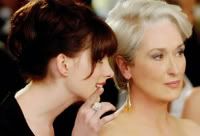 Frustrated with her demanding and unreasonable boss, Andy seeks advice from Nigel (Tucci), who helps her transform into something that Miranda could take more seriously. It works. As Andy's confidence improves, her ambition to win Miranda's trust and approval becomes stronger. She starts to cater to Miranda's every need, ridiculous schedule and demand at the expense of her own personal life, jeopardizing her relationship with beau, Nate (Grenier). Before she knows it, she's becoming more and more like Miranda.
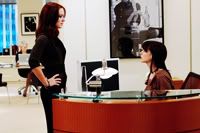 Streep (The Prairie Home Companion) has found a delicious role in Miranda Priestly. Her portrayal of the ice queen is perfection, what with her dead glares and a voice that never rises above certain level and yet filled with barbs. You simply can't take your eyes off of her. In comparison, Hathaway (Brokeback Mountain) is slight and obviously inexperienced. However, her genuine disposition and earnestness are very fetching, and her awkwardness around Streep is actually an asset to the role.
Blunt (Irresistible) is perfectly cast as Miranda's shallow but amiable first assistant, Emily. She manages to turn in a fun and nuanced performance, showing us a nice, mean edge but also vulnerability. Tucci (Lucky Number Slevin) has a great time playing the flamboyant but kind art director, even though the character is rather stereotypical and one-dimensional. Grenier (Entourage) has a nice supporting role as Andy's sweet and understanding boyfriend. Baker (Something New) plays Christian Thompson, a charming author with an ulterior motive. Rounding out the cast are Thoms (Rent) and Sommer (Death 4 Told) in minor roles as Andy's best friends and conscience.
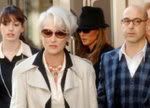 The script by McKenna (Law of Attraction) has a light and fluffy feel matching the tone of Weisberger's best-selling semi-autobiographical novel. The Devil Wears Prada is a satire, an exposé of the brutal and superficial world of fashion (and publishing) in the guise of a coming-of-age story. The observations are generally sharp and witty, but also superficial and cartoonish (the jabs at wafer-thin models or insecure fashion designers are trite) at times. The story itself isn't all that fresh, and is quite predictable. What is fun about the film is the subject matter and the character of Miranda Priestly. Streep is a joy to watch.
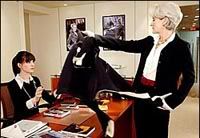 Director Frankel (Entourage, Sex and the City) is mostly known for his television work. He instills a good sense of humor in this production, and the pace is impeccable. Mostly, he seems to stay out of his actors' way and let them do their job. Streep, for example, makes you believe that she is the devil incarnate but in fact, she is much of a slave herself to the real devil: fame, power and fortune. The question Andy has to ask -- "Who are you and what do you want in life?" -- isn't really that deep or profound or earth-shattering. The good thing is that the film doesn't take itself too seriously. Everything is handled in a tongue-in-cheek fashion. That makes it a devil of a good time.
 Stars: Meryl Streep, Anne Hathaway, Emily Blunt, Stanley Tucci, Adrian Grenier, Tracie Thoms, Rich Sommer, Simon Baker, Daniel Sunjata
Director: David Frankel
Writers: Aline Brosh McKenna (based on Lauren Weisberger's novel)
Distributor: 20th Century Fox
MPAA Rating: PG-13 for some sensuality
Running Time: 109 minutes
Ratings:
Script – 7
Performance – 8
Direction – 7
Cinematography – 8
Music/Sound– 7
Editing – 7
Production – 8
Total – 7.3 out of 10


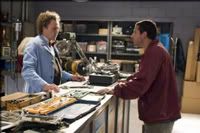
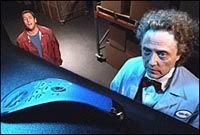
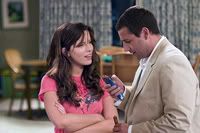 New York architect Michael Newman (Sandler) is overworked and under-appreciated by his boss Ammer (Hasselhoff). In turn, he's neglecting his lovely wife Donna and two kids. He needs to regain some control of his life and the first thing he wants is a universal remote control. At a Bed, Bath and Beyond store, he meets Morty, who gives him a slick "universal" remote that may solve all his problems.
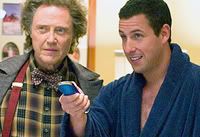 Sandler (The Longest Yard) is his usual schmuck in Click. His overacting, childish brand of acting seems to fit the kind of stories he's telling. Still, he's way too immature for a hot shot architect to be completely believable. And one does wonder: what is a beauty like Beckinsale (Underworld: Evolution) doing with a schmuck like him? She is smart, funny, loving, sweet, and gorgeous. Fortunately, Sandler and Beckinsale do share a nice chemistry, so this pairing isn't a total disaster.
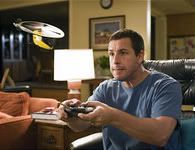 The story by Koren and O'Keefe (Bruce Almighty) is nothing new. It's basically a funny version of It's a Wonderful Life. Director Coraci (Around the World in 80 Days) has a frantic style that is quite suitable for the film. The make-up is outstanding, though, and the futuristic sets are interesting.
  As a fluffy comedy, Click works within the genre and the theme of "slow down and live your life" is universal and popular. The characters are cartoonish but, again, it works for the genre and they're generally funny. Interestingly, it's Sandler who is the weakest link here. In a way, it's as if Sandler demands too much attention on himself ("hey, look, I am the funny guy!") instead of working with the rest of the cast. I wouldn't recommend anyone spending ten bucks on this, but if it's just a click away on TV on a boring Saturday night, go for it.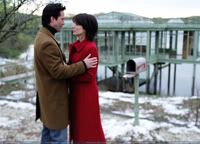
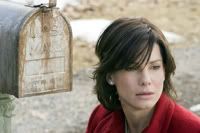 Soon, they realize that they exist in two different times, exactly two years apart. Their only connection with each other is the magical mailbox and the letters they leave for each other. Through their letters, they start to get to know each other. Curious, Alex crosses path with Kate in 2004, who obviously doesn't know him and is living with her boyfriend Morgan (Walsh). The love between Alex in 2004 and Kate in 2006 grows as they continue to confide in each other. Soon, Kate decides that she must meet Alex in 2006 and settles this once and for all.
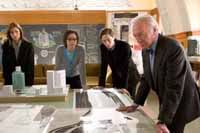 The supporting cast is strong in their relatively small but well-developed roles. Aghdashloo (X-Men: The Last Stand) is warm and affecting as Kate's colleague, Dr. Klyczynski. Plummer (Inside Man) is cold, proper and pompous as Alex's father, Simon Wyler, a Frank Lloyd Wright-like architect. Moss-Bachrach (Live Free or Die) is earnest and sincere as Alex's younger brother, Henry. Walsh (Nip/Tuck) is solid as Kate's lovelorn ex-boyfriend, and Dutch actress Ammelrooy (Lulu) is sweet as Kate's widowed mother.
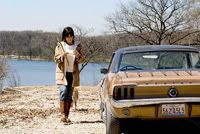 Under the deft direction of Agresti (Valentin), the film excels in many areas. As a love story, the film has a wonderful romantic look and feel to it; the atmosphere is spot on. The cinematography is rich, soft, and oh-so-romantic. The themes of separation and waiting also serve the story well. The concept of the letters are a bit old-fashioned, but it plays well in an essentially old-fashioned love story. The characters are well-developed and real, not just cardboard cutouts. The clever editing helps tell the story, too, but it could use some tightening to clarify the timelines and paradoxes. I keep asking myself why can't they just meet in 2004 (or 2006) and get it over with? The answer comes later.
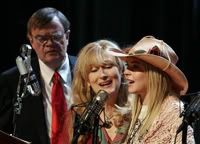 The performers wrestle with their sadness and professionalism during the very last show. They include the Johnson Sisters, Yolanda (Streep) and Rhonda (Tomlin) and the funny, singing cowboy duo Dusty (Harrelson) and Lefty (Reilly). During the performance, security officer Guy Noir (Kline) notices a mysterious woman in a white trench-coat (Madsen) who seems to appear and disappear at random. As the show approaches its end, the emotions become insurmountable for some and they all hope that perhaps this performance really won't be their last.
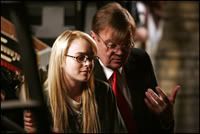 The all-star cast of actors have earned enough Oscars to fill the sound stage. There is Streep (The Devil Wears Prada), whose versatility continues to amaze and enthrall us. Her emotional yet restrained performance as the frumpy, babbling, reminiscing songster is sweet and nuanced. Likewise, Tomlin (I Heart Huckabees) is the counterpoint of Streep as her equally babbling, reminiscing but more-showy sister Rhonda. Their chemistry is beautiful. Lohan (Just My Luck) is less impressive as Yolanda's morose teenage daughter. It's not that she's a bad actress, but she definitely pales in the company of these veterans.
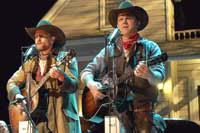 In fact, Keillor's script is an intricate character study wrapped in a thin veil of plot, which is really secondary. The story is based on the real-life show "A Prairie Home Companion" which he started in 1989. The story is more about the gamut of emotions (or the lack of) during the last two hours of the radio show. The myriad of quirky characters are the focus here, and through the dialogue and their interaction with each other, we get a glimpse of their lives and what the radio show means to them. The main plot, namely the demise of the show, only serves as a backdrop. In fact, I wonder if the story would have been even stronger if we'd skipped the plot line concerning Madsen's character. Certainly, that part of the story is interesting, but I do question its usefulness in a story like this.
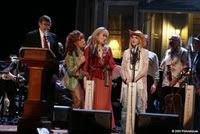 Altman (The Company) is, as usual, fluid and exquisite in his execution. In fact, I am not sure if Altman knows how to make a film with only a handful of characters. He seems to revel in the presence of a large, highly-celebrated cast that is well-trained in giving nuanced performances. In fact, he often lets, or requires, his actors to improvise. The scenes with Streep and Tomlin, for example, are mostly improvised. Altman has a knack for bringing out the best in his actors, and his actors, in turn, love to work with the legendary director. While A Prairie Home Companion is not his most endearing or successful endeavor, it is a perfectly fine companion to his other masterpieces.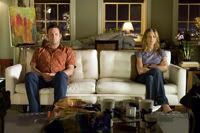
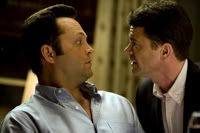 But paradise doesn't last forever. Soon the differences between Brooke and Gary become so unbearable that after a dinner party with both families, a fight between the couple escalates and Brooke calls it quit. Unfortunately, neither of them can afford or is willing to move out. The living situation turns in to a bitter war between the ex-lovers. The fact is, Brooke doesn't really want to leave Gary; she simply wants him to change for fear of losing her. Gary doesn't want to leave either, but he's too proud to apologize and admit that he's in the wrong, and he doesn't think Brooke cares. Their battles become not a war to get rid of each other, but one to hang on to their relationship.
 Vaughn (Wedding Crashers) has, in recent years, reinvented himself as a great comic actor. We tend to forget that he has talents in dramas as well. In a way, Vaughn wants to remind us that he could do both in The Break-up. In all fairness, Vaughn is a strong player in the movie -- it is one of his better performances. Unfortunately, his character is so selfish, self-absorbed and clueless that it's hard to sympathize with him. Likewise, Aniston (Friends with Money) tackles her character with wit and heart, but try as she may, Brooke comes off as whiny, manipulative and self-pitying. While the two leads have great chemistry together, we simply don't get enough of the "love" between them to care about their petty break-up. In fact, at times, we just want to scream, "Move out and get it over with already." And that's the major flaw of this good-intentioned film.
 In addition, Bateman (Dodgeball) has a good, brief show as the voice of reason that has an ulterior motive. Davis (Marie Antoinette) is outrageous as the eccentric artist, Marilyn Dean, and Long (Dreamland) plays a stereotypically gay assistant. Ann-Margret (Tales of the Rat Fink) has a cute cameo as Brooke's mother and D'Onofrio (Thumbsucker) is interesting as Gary's uptight brother. The standout is Higgins (Fun with Dick and Jane) as Brooke's song-and-dance-loving, supposedly "gay" brother, Richard. The scenes with Higgins and Vaughn are hilarious. Unfortunately, none of these characters are given enough opportunity to shine and develop.
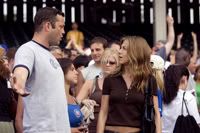 The screenplay by Garelick (Is This Your Mother) and first-time writer Lavender is surprisingly dark and petty. Reed (Down with Love) is adequate as director. The story opens with enough innuendoes and humor to keep us amused, but as Brooke and Gary engage in a head-on psychological war, the story becomes tedious and insufferable. The leads become increasingly unappealing. Such cruel development would work in a satirical piece such as Michael Douglas' classic War of the Roses. Unfortunately, the filmmakers try too hard to be "real" here that the result quickly becomes a dreck. It's never fun watching two people fight about petty things, especially when the solution is so obvious to everyone else. Yes, the film is entitled The Break-Up, but if the writers had devoted more time developing the characters and the relationship between then before the break-up, it would be a more balanced and satisfying film.