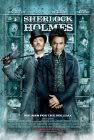
Sherlock Holmes and John Watson are probably two of the most well-known and beloved literary characters in the world. So how would director Guy Ritchie attempt to make them fresh and relevant to 21st century audiences? By casting the ever-popular Iron-Man as Holmes, of course.
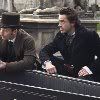 Holmes (Robert Downey Jr.) and Watson (Jude Law) are partners in solving crimes in turn-of-the-century London. Their latest case leads them to Lord Blackwood (Mark Strong) who has killed five women already while practicing his dark magic. With the help of Inspector Lestrade (Eddie Marson), they're able to capture Blackwood. The problem for Holmes is that he has nothing to do while awaiting Blackwood's execution. Watson tries to get Holmes out of the house, and introduces Holmes to his fiance, Mary (Kelly Reilly). Holmes shows no interest in either. Before his execution, Blackwood promises Holmes they will meet again and next time, he will drive Holmes mad.
 Then Holmes' nemesis, Irene Adler (Rachel McAdams), shows up meddling with Holmes' affairs. He wants to find out for whom Irene works. Meanwhile, Lord Blackwood is seen rising from his grave. His resurrection shakes London and puzzles Holmes and Watson, who don't believe in magic. But the fact is there: Watson was the one who pronounced Blackwood's death! To prevent the "end of England" as Blackwood has promised, Holmes and Watson must race against time and risk their lives to solve the mystery.
 Robert Downey Jr. (Iron Man) gives Holmes a much-needed update with superb energy and charm. His Holmes, however, comes across as an alter-ego for Tony Stark instead of a methodological scientific man of logic and reasons. More often than not, I find Downey unconvincing as the famed sleuth. Perhaps I'm biased by the previous Holmeses; perhaps I find Downey's performance too perky and goofy for my taste.
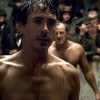 Jude Law (The Imaginarium of Doctor Parnassus) is, on the other hand, perfect as Watson with his cool charm and slightly awkward mannerisms. He's at once very old British and contemporary. It does help that he and Downey have good chemistry together and their bickering is fun to watch. Rachel McAdams (The Time Traveler's Wife) is spunky and sharp as Irene, but somehow her role as the "third banana" is lost in the plot. In fact, her character seems extraneous in this story. Certainly she could be a major player in future sequels, but in this film she's almost a throwaway character.
 Mark Strong (Young Victoria) is appropriately evil as Lord Blackwood, but he, too, doesn't have much to do except to appear and act evil. His character is poorly drawn and lacks depth. Eddie Marson (Me and Orson Welles) is effective as Inspector Lestrade. Kelly Reilly's (Pride & Prejudice) talent is rather wasted as Mary, but William Houston (Fifty Dead Men Walking) is sympathetic as Constable Clark.
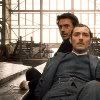 Written by an army of writers including Michael Robert Johnson and Anthony Peckham (Invictus), the screenplay shows the haphazard nature of the process. It's busy, complicated, and it sometimes lacks coherence. I was having a bit of a hard time understanding the dialogue and the plot early on. As the story progresses, I was able to find the coherence and understand it better. Still, there are too many "distractions" that do not serve the plot or even the character development. They seem superfluous.
 I do enjoy the interactions between Holmes and Watson, and to some extent the interactions between them and Irene Adler. I just wish the writers could balance those better with the plot advancement and keep everything as seamless as possible.
 Director Guy Ritchie (RocknRolla) tries too hard to be hip and contemporary while making a movie about turn-of-the-century London. The sets are great, the special effects are superb, and the costumes are beautiful. The production is handsome and looks expensive. But the lack of coherence and focus is partially Ritchie's fault. The editing seems choppy and the MTV-style of camera movements and angles can become disconcerting.
Not to mention the fact that mysteries are fun to watch because the audience could deduce the outcomes and figure out the clues. The main problem I find with this story is that there just aren't that many clever clues, or resolutions, for that matter. The main mystery is predictable. As for the rest, the filmmakers make the unfortunate decision to gloss over all the clues, and then have Sherlock Holmes explain everything at the end with rapid-fire commentaries. That's not what I expect from a mystery. In fact, the whole movie is more of an action-adventure thriller. The mystery is secondary. If that's what we want, I don't have a problem with that.
As an action-adventure, Sherlock Holmes is fun and entertaining and fulfills its goal of luring young people to these characters and old settings. It probably succeeds in making Sherlock Holmes and John Watson hip and relevant again. But as a mystery, it fails on many levels, what with the lame clues, the predictable outcome, and extraneous subplots and characters. It is a disappointment for mystery fans, and it doesn't take Sherlock Holmes to figure that one out.
Stars: Robert Downey Jr., Jude Law, Rachel McAdams, Mark Strong, Eddie Marsan, Robert Maillet, Geraldine James, Kelly Reilly, William Houston
Director: Guy Ritchie
Writer: Michael Robert Johnson, Anthony Peckham, Simon Kinberg, Lionel Wigram (based on Sir Arthur Conan Doyle's characters)
Distributor: Warner Bros.
MPAA Rating: PG-13 for intense sequences of violence and action, suggestive material
Running Time: 128 Minutes
Ratings:
Script – 6
Performance – 7
Direction – 7
Cinematography – 8
Music/Sound– 8
Editing – 7
Production – 8
Total – 7.0 out of 10


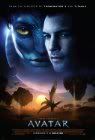
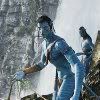 Jake Sully (Sam Worthington) is a paraplegic ex-Marine who is now recruited by "the company" to go to a distant planet called Pandora. The company, headed by Parker Selfridge (Giovanni Ribisi), consists of two rivaling branches: the peaceful scientists, led by Dr. Grace Augustine (Sigourney Weaver), who try to study and learn from the planet and its most-intelligent beings, the Na'vi; and the military, led by Col. Quaritch (Stephen Lang), whose objective is to get what they want (a highly precious mineral) by any means.
 Jake is to join Grace's team as his deceased twin brother was one of her scientists. His brother studied the Na'vi and volunteered in the "Avatar" program. By mixing human and Na'vi DNAs, Grace's team is able to create bodies of Na'vi and connect their brains to the human hosts, thus letting the human become "puppet masters" of their Na'vi avatars. Since Jake is an identical twin, he is able to take over for his brother. Quaritch, on the other, has other plans. He wants Jake to spy for him, to learn all about the Na'vi and their weaknesses. He gives Jake three months to determine if the Na'vi will be able to relocate, or else they will use brute force.
 Through his avatar, Jake is able to gain the trust of the Na'vi, especially the chief's daughter, Neytiri (Zoe Saldana). She is assigned to teach Jake what he needs to know about the Na'vi's way of life. During that time, Jake slowly gets involved with the Na'vi culture and eventually feels more attached to the "savages" instead of the humans. He is conflicted about his role in this operation. When it's apparent that Quaritch has no intention of letting the Na'vi live, Jake must choose between his own race or his adoptive family.
 Sam Worthington (Terminator Salvation) plays a dual role, both as the human and the Na'vi avatar through sophisticated motion-captures. Ironically, Worthington's performance comes alive when he's being "rendered" by the animators. As the ex-marine, he's passive and, in many ways, rather dumb. But as the Na'vi avatar, he is physically powerful and emotionally expressive. Zoe Saldana (Star Trek) is wonderful as Neytiri. The MoCap truly captures her expressive face and subtle movements. Her character is amazing to watch because it is one of the most lifelike animation ever.
 The human characters are by and large caricatures and two-dimensional, with the exception of Sigourney Weaver (Baby Mama), who gives her character a strong personality and warmth. Michelle Rodriguez (Fast & Furious) is also sympathetic as the soldier with a conscience. Stephen Lang (The Men Who Stare at Goats) is, on the other hand, a through-and-through bad guy. There's absolutely no depth in his character and Lang plays it strictly evil. Giovanni Ribisi (Public Enemies) also has the thankless job of playing a stereotypical corporate weasel. Meanwhile, Joel Moore (Stuntmen) plays a typical second banana.
 The screenplay written by director-writer James Cameron (Titanic) is a mixed bag. Avatar is Cameron's first feature film since Titanic 12 years ago. The story is a rehashed tale of Dances with Wolves: a typical hero's journey through understanding and redemption. It follows a clichéd story arc and includes genre archetypes. There's nothing new about the story. In fact, much of it is tiresome and predictable. The dialogue is clichéd and, at times, silly. There are many plot holes that will make your head explode if you think too hard about them. And forget about the pseudo-science: Avatar is a fantasy set in space. There's no surprise at all. We know where the story is going and how it's going to end.
 What is surprisingly, however, is the details Cameron puts into the plot. His imagination of Pandora is fantastical, even though maybe a bit too much of a fantasy. Cameron borrows heavily from fantasy tropes (Flying dragons? Trees of life?) as well as native American and African folklores. The result is surprisingly rich and detailed.
 While Cameron may falter in screenwriting, he compensates in the direction and visual effect departments. The photorealistic special effects are nothing new -- Spielberg gave us photorealistic dinosaurs almost 20 years ago and Cameron himself gave us a photorealistic rendering of the Titanic. However, what Cameron has accomplished, through sophisticated animation, visual arts, motion capture and 3D technologies, is creating a multi-layered, three-dimensional world that truly is amazing to behold. He's succeeded in putting us in that world. At first, there's still that "computer graphics" look to the film, what with the washed-out color palettes and CGI that is somewhat too perfect and sharp. But as the film progresses, it's amazing that I would suddenly realize I'm actually not looking at something real, because everything looks so real.
 The story begins with Nelson Mandela's (Morgan Freeman) release from prison, during a time when South Africa remains deeply divided because of apartheid. Mandela's eventual historical win as President further unsettles his country where a minority of whites control the majority of blacks. His victory comes with intense scrutiny, indifference and anger. Whites are fearful of the future, where retaliation is possible. South African blacks feel they've been vindicated, and they want revenge on the whites who persecuted them.
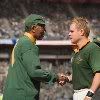 Instead, Mandela believes the only way to rebuild the country is to put aside all the anger and hurt and finger-pointing and work together, that they can't fight racism and apartheid with more prejudice and segregation. For example, he deliberately includes whites in his secret service team. When he hears that the sports council wants to dissolve the losing Springbok, their national rugby team (rugby is mostly a "white" sports in South Africa), he decides a different tactic is in order. Instead, he invites team captain Francois Pienaar (Matt Damon) for a chat. It seems that Mandela believes a great way to unite the country is by uniting them through rugby.
 Morgan Freeman (The Dark Knight) is the perfect choice to play Mandela -- even the President himself said only Freeman could play him. Both got their wishes. Freeman embodies Mandela's mannerisms and spirit and gives us an earnest performance of an earnest man. However, Freeman falls a bit short of completely disappearing in the role, as he's simply too well-known. The similarities between the two men are actually distractions. At times, I'm not sure if Freeman is playing Mandela, or whether he's playing Morgan Freeman playing Mandela.
 Matt Damon (The Informant) shed his excess weight and gained muscles to play Francois Pienaar, a towering, rugged athlete in real life. Damon has to project himself bigger than life while coming off as down to earth and personable. It's not easy. In a way, Damon is probably too gentle and quiet, even though that may be who Pienaar is in real life; but on the big screen, we expect more personality. His accent is also uneven. In truth, Damon seems more of a minor character -- Freeman dominates the film, as expected.
 The support cast is comprised of mostly unknown South African and British actors: Tony Kgoroge (Blood Diamond) as Mandela's chief security Jason Tshabalala, Patrick Mofokeng (Man to Man) as Linga Moonsamy, Matt Stern (District 9) as Hendrick Booyens, and Julian Lewis Jones (Torchwood) as Etienne Feyder, and Adjoa Andoh (Doctor Who) as Mendela's right-hand woman, Brenda.
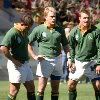 Written by Anthony Peckham (Sherlock Holmes) who is South African, the screenplay seamlessly combines the socio-political and sports aspects of the story, using one to reflect on the other. In many ways, it's a perfect juxtaposition -- there are plenty of parallels between politics and sports. Racism is, of course, front and center. For the most part, the themes of racial tension are riveting and relevant. At times, however, they become heavy-handed. Peckham also glosses over many the deeply divisive matters. Certain parts of the film, while "inspirational," seem forced, contrived and too rose-colored.
 The predictability serves the film well as a sports flick, but lacks gravitas and substance in terms of the deep-rooted racism and social inequality in South Africa. In that sense, the film focuses too much on the "feel good" factor, making light of the real social, economical, and political problems Mandela faced. At the end, it feels too light, no matter how rousing the ending may dictate.
 Director Clint Eastwood (Gran Torino) is skillful in balancing the drama and action. The first half of the film is particularly interesting as we navigate through Mandela's plight in his first term as the first black president of a greatly divided country. But as the film progresses and the focus rests on the Springbok's effort to win the World Cup, the film becomes bogged down by many of the sports film cliches. That's when the message becomes heavy-handed, the rousing musical score and the slow-motion action sequences typical of the genre. Mandela also becomes a backdrop. The crowd-pleasing final reel is predictable and entertaining, but it lacks the emotional punches we've come to expect.
 Frank (Robert De Niro) is a recently widowed father of four adult children: Amy (Kate Beckinsale), Robert (Sam Rockwell), Rosie (Drew Barrymore), and David (Austin Lysy). On a holiday weekend, Frank is expecting them all to convene at the family house -- the first family gathering since the funeral. One by one they cancel on Frank. Instead of moping around, Frank decides to travel across the country to surprise his children, despite the objection of his doctor due to Frank's health issues.
 Frank visits David, his youngest and an artist, first in New York. But after waiting outside his apartment for a day, Frank never gets to see his son. Next, he travels to Chicago to see Amy, is a senior advertising executive. However, Amy insists on Frank leaving to see Robert in Denver instead, because she and her husband are extremely busy. When Frank arrives to see Robert, who works in the symphony, he gets a similar response. Feeling rejected, Frank reluctantly makes his final trek to see Rosie, a dancer in Las Vegas.
 Through this trip, Frank realizes he's spent more time on the road than with his children, much like the way he was when the kids were growing up. He also realizes that he doesn't know anything about them. When his wife was still alive, she served as the mediator between the children and him. They told their mother everything. But only good news would filter through to Frank's ears. During the trip, Frank makes startling discoveries about his family, and ultimately about himself as a father.
 Robert De Niro (Righteous Kill) is a great actor -- we all know that. Still, it's a pleasure to see him in a small, intimate role that allows him to flex his thespian muscles. His portrayal of Frank, a common man, is nuanced and subtle and affecting. There's a also a genuine quality to his performance that you hardly think he's acting. He makes you see the flaws in his character but, at the same time, feel for and identify with him.
 The actors who play the adult children all hold their own against the master. Kate Beckinsale (Whiteout) is superbly collected as the overachiever, but you can see the seams falling apart around her. Sam Rockwell (Moon) is more than capable to upstage De Niro, if that's possible. Rockwell has a hard edge about him and that works extremely well for his character. Drew Barrymore (He's Just Not That Into You) plays an extension of her off-screen persona, but she fills that role so well that you hardly notice. It's good to see her in a mature role, however.
 Written and directed by Kirk Jones (Waking Ned), the story is gentle and subtle. From the opening shots of Frank doing yard work to the final scenes, Jones manages to make everything come across as genuine. The dialogue is natural. He also includes minor characters who complete the story without being relevant -- much like real life. The focus doesn't waver away from Frank, however. We get to experience the journey -- and it is one heck of a journey both physically and emotionally -- from Frank's perspective, with the occasional reveals from the children's side.
 It is when the story briefly cuts away from Frank (mostly to reveal a central plot point) that the narrative seems to falter a bit. I understand the reasons and thematic importance, but somehow I feel the revelations could have been handled differently. There are also a few contrived moments just to keep the plot moving.
 Jones' down-to-earth style also adds to the authenticity of the film. Mostly, he lets his actor do their thing. He also uses a few interesting cinematic trick to convey to us Frank's mentality and sentiments, without using voiceovers. Some may argue these techniques as heavy-handed, but I like them. They gives the story extra layers and deeper emotions. Perhaps I'm a sucker for stories about parent-child relationships -- a few scenes did manage to choke me up.
 Charlie (John Travolta) and Dan (Robin Williams) have been friends and business partners for over 30 years. Charlie, despite being in his 50s, is a player. Dan, on the other hand, is unlucky in love. They're on the verge of making the deal of their lives with a Japanese company. Then Dan's one-time flame Vicki (Kelly Preston) shows up and drops the bomb on him: he's the father of her twin 7-year-old children.
 What's worse, Vicki is scheduled to serve some jail time, and situations arise such that she is desperate to find someone to care for the children for two weeks. Dan is horrible with children, but he wants to spend some time with his own children, so he reluctantly agrees. He also coerces the equally inapt Charlie to help him.
 Meanwhile, the babysitting situation is interfering with their business deal. The children demand a lot of Dan's time, and he can't do it without Charlie. The two "old men" try their best to keep up but they're met with a series of mishaps that threaten both the deal and Dan's relationship with the kids.
 John Travolta (The Taking of Pelham 123) hasn't done a comedy for a while, and he's okay as the middle-aged playboy. His comic timing is fine but the performance errs on the overacting side. In fact, such can be said about most of the performances in the movie. Robin Williams (Night at the Museum), believe it or not, is the restrained one. He juggles between playing earnest and goofy, channeling Mrs. Doubtfire (who is also trying to play nice with his own kids).
 Nepotism seems to be in vogue here, with Travolta's wife, Kelly Preston (Sky High), playing Dan's old girlfriend and mother of his children. She's agreeable, although she and Williams don't really have much chemistry; thankfully, her role is minor and her screen time is limited. Travolta's teenage daughter, Ella Bleu, makes her debut playing one of Dan's twin. Her performance is unremarkable, to say the least. Conner Rayburn (The Invention of Lying) does a matter job as her twin brother. He has a memorable face and a goofy grin that is rather affecting.
 The movie also boasts many guest stars, including Lori Loughlin (90210) as Charlie's love interest, and Seth Green (Sex Drive) in a throwaway part as Dan and Charlie's protege. Other cameos include the late Bernie Mac, Matt Dillon, Ann-Margret, Rita Wilson, Amy Sedaris, and Justin Long.
 Written by David Diamond (Minutemen) and David Weissman (Minutemen), the screenplay shows how inapt the two are as writers. The story is paper-thin and the situations are forced. The jokes are recycled (for example, yes, we've seen the "tanning gone wrong" bit before; and tell me why Dan isn't mad as hell after that incident) and contrived. The ending is, of course, predictable.
 As a comedy, though, they should at least make us laugh. The problem is, many of the funniest parts have already been shown in the trailers. There are other funny moments, but mostly the jokes are cringe-worthy and cliched, not to mention ageist. How many times can we laugh at these two guys being "old"? The "grandpa" joke gets old really quickly. Much of the comedy relies on humiliating the two leading men but doesn't serve the story -- I mean, really, getting hit on the crotch, repeatedly? The comedy also depends on racial, ageist and sexist stereotypes.
 Precious (Gabourey Sidibe) is a 16-year-old welfare child of Mary (Mo'Nique) living in Harlem. She's also pregnant with her second child, and is now flunking out of junior high school. Mary is abusive and negligent; she's using her daughter and granddaughter only for the welfare checks. Precious has to go behind her mother's back to go to an alternative school, trying to get her GED so she can get out of her personal hell.
 At the alternative school, Precious meets a number of poor, under-educated girls just like her. Her English teacher, Ms. Rain (Paula Patton), discovers even though Precious has had good grades in junior high, she's practically illiterate. Ms. Rain encourages all the girls to read and write every day. Just when things start to look up for Precious, she has her baby son.
 Eventually, Mary finds out what's going on and accuses Precious for ruining her life. Her abuse on the baby becomes the last straw for Precious, who walks out. With Ms. Rain's help, Precious moves into a halfway house and, within a year, she reaches a 6th grade reading level. Just when she thinks everything is going to be okay, her mother pays her a visit and delivers devastating news.
 Precious is Gabourey Sidibe's (Yelling to the Sky) first feature. She's obviously green but her lack of acting experience may have been her biggest asset in the role of Precious. Sidibe comes off as extremely genuine and naive. Her character is stuck between a hellish reality and glamorous fantasies. Sidibe's understated performance makes us care for the character.
 Mo'Nique (Welcome Home, Roscoe Jenkins) is wonderfully disturbing as Precious's mother. What's great about her performance is that she does not rely on the stereotypes -- sure, the character is a walking, talking stereotype of every negligent welfare mother, but Mo'Nique somehow gives the character depth. You want to hate Mary, but at the same time you feel sorry for her.
 The supporting cast includes Paula Patton (Swing Vote) as Precious's kind teacher. Patton's beauty and elegance are distracting, however. Often she looks like she's just walked off a movie set instead of being a Harlem teacher. On the other hand, Mariah Carey (Tennessee) goes "ugly" to play the dowdy welfare worker. It's nice to see the singer-actress give an understated performance that is grounded in reality. Sherri Shepherd (Who's Your Caddy) has a small role as an alternative school administrator, while singer Lenny Kravitz (Novella) is amiable as a sympathetic nurse who befriends Precious. The "girls" are effectively portrayed by Stephanie Andujar, Chyna Layne, Amina Robinson, Xosha Roquemore, Angelic Zambrana, and Aunt Dot.
 Geoffrey Fletcher works hard to adapt Sapphire's difficult novel and gives the character-driven story some kind of a plot. Still, plot is an abstract; the strength of the story is the characters, and their dysfunctional relationships. Except for the saintly Ms. Rain, every character is flawed and broken in some way. Fletcher keeps it real most of the time, and presents the fantasy elements as Precious's escape from her reality. He takes his time to peel away the layers and reveal more about the characters. Still, there are some scenes that are too abstract or up for interpretation. The subtlety could be difficult to decipher.
 The story also touches on very difficult and disturbing subjects, including child abuse and incest. I applaud Sapphire for her unflinching descriptions of reality and Fletcher's uncompromising adaptation. And I applaud the actors for portraying these difficult roles and handling the horrific subject matters with honesty and dignity.